
The Impact of the Israeli/Iranian War on Syria
- sara john
- Sep 4, 2025
- 7 min read

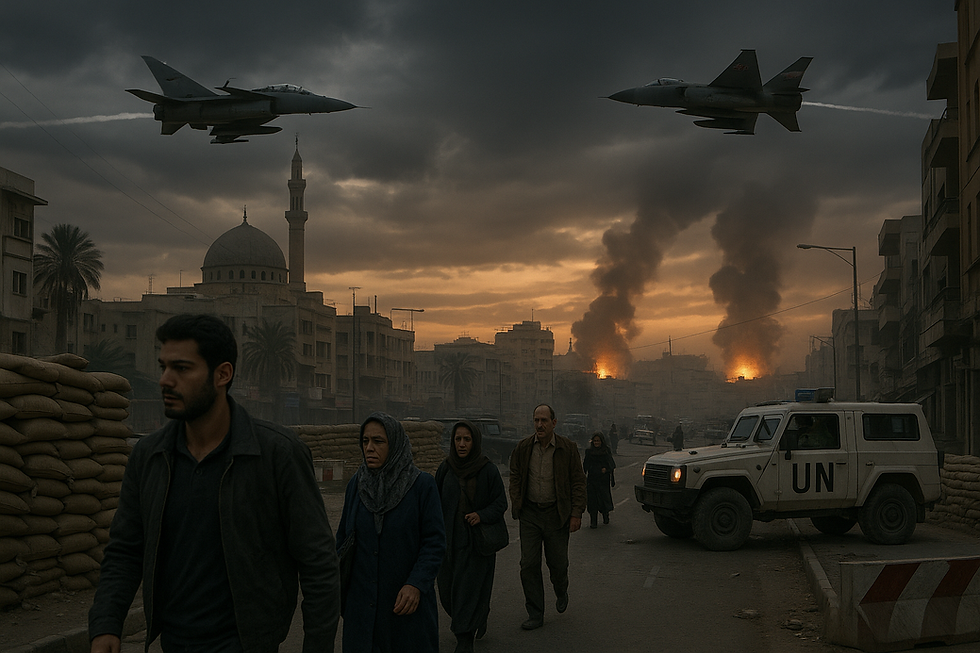
Preserving Regional and National Peace Requires Complex Diplomacy to Avert the Consequences of Uncertainty and Repercussions
The dominance of power dynamics in international relations has never been as evident in world history as it is in the current international system. Indicators of global power hegemony are reflected in: the policies of the Trump administration, the Russian-Ukrainian war, American trade tariffs on world nations, Trump’s imperialist tendencies in neighboring regions (Canada, Panama, Mexico, Greenland, and the Kingdom of Denmark), and the arrogant manner displayed in Trump’s reception of fellow heads of state—bereft of protocol and diplomatic norms. Yet the manifestations of dominance appear most clearly in one particular region of the world: the Middle East, as evidenced by the wars waged by Israel’s far-right government.
By Dr. Samir Al-Taqi
In an attempt to assess the repercussions of the Israeli/Iranian war on Syria, we began with an extensive study employing applied mathematics protocols supported by artificial intelligence to evaluate risks, identify consistencies and tendencies of events, and forecast possible scenarios. The mathematical study described the situation in Syria and its surrounding sphere as “extremely complex and chaotic, with cascading risks likely to unfold.”
In this brief paper, we draw upon our previous, more extensive research following the Israeli–Iranian war. The core recommendation then was: “the necessity of exercising the utmost degree of strategic caution in responding to the transformations surrounding Syria.”
With an Israeli decision, the war broke out—a war which Netanyahu himself affirmed he had been planning for decades. Dormant risks erupted, chaos factors (the overlapping “Pandora’s Boxes”) interwove and completely surpassed human wills and accords, producing instead a random shock within a fragile regional and international system (as per Helbing). In such a context, any misstep in conventional deterrence becomes a prelude to runaway escalation.
To study these repercussions, we propose analyzing three systems:
The first system: the factors of chaos and uncertainty in international conflicts.
The second system: regional instability—both near and far—around the Levant, whose repercussions extend toward the Arabian Gulf.
The third system: the Syrian domain, with complexities that verge on the impossible.
How did this war end?
How did this upheaval, which it represented, penetrate the entirety of Syria’s surrounding strategic frameworks? It combined factors of chaos and randomness, generating feedback loops that compounded each other, such that alliances between friend and foe inverted (Chang et al., PNAS Nexus (2023)). Minor shifts unleashed complex consequences, making it impossible to rely on “moderate” scenarios.
The Syrian Internal System
The Syrian system is undergoing internal transformations that generate intense disruption, striking at the very roots of the possible state model, making Syria a space extremely sensitive to the disturbances of the regional and international environment.
The Regional System
Israel: In the war, Israel was able to confirm its overwhelming offensive superiority, but it did not confirm, to the same extent, its defensive resilience. Structural flaws in its strategic posture were exposed. At the same time, Israel practically tested the United States’ commitment to it, but it also tested the ceiling of American willingness to become directly involved.
However, Israel, which after October 7 decided to settle the regional cold war in its favor and to cement an “Israeli regional peace,” was unable to transform its military and security successes into political achievements that would secure the final collapse of Iran’s national will and end hostility toward the Jewish state. It did not resolve the nuclear or missile files. Nor does the current Israeli government appear to have a strategy to exit its cycles of war, including its failure to alter its strategic position with Syria. Thus, it finds itself returning once more to a new cycle of “mowing the grass” and a cold war with new regional adversaries.
Iran: Iran’s political, security, defensive, and strategic systems proved frail and brittle. Its regional outposts collapsed before it. Nevertheless, Iran held together and fought Israel with its eyes on the United States, betting on the absence of an American will to continue the war. As usual, it was able to absorb the blow and move toward protracted negotiations, awaiting the restoration of its national deterrence and the reconfiguration of its alliances with Russia, Pakistan, and China—at a time when it itself is undergoing deep internal structural transformation.
Iran, after this war, will never again be the same!
According to the debates found in Iranian research centers and media outlets—as we noted in a previous study in this esteemed journal—uncertainty surrounds the power struggle in Tehran, which unfolds both covertly and openly, within and beyond the ruling establishment: from the Pasdaran (Revolutionary Guard), and the military and governmental bureaucracy, to the bazaar and the various social and ethnic forces. At the top of this, emerges…
The International System
The United States: In the twelve-day war, America reaffirmed its global strategic supremacy over its international rivals on one hand, and its stormy return to the region on the other. Yet it also confirmed its failure to resolve the crisis with Iran—or any of the region’s crises—and it was unable to demonstrate its commitment to Gulf security.
Meanwhile, U.S. regional strategy is pulled between two contradictory approaches:
The Israeli approach, which bets on perpetuating conflict and keeping the American hammer ready.
The alternative approach, which invests in the Saudi-Arabian vision focused on building peace, prosperity, and development.
However, in the end, the United States leans toward the second option, since it is not ready—neither internally nor externally—for regional entanglement, nor for a campaign similar to its operations in Iraq in 1991 after the liberation of Kuwait, let alone ground troop involvement. Meanwhile, for many American strategists, Iran remains the “crown jewel.”
While the fall of the Assad regime would have dealt a fatal blow to Iran’s regional strategies, the United States hopes it can manage the conflict between its allies Turkey and Israel in terms of the division of regional responsibilities. Ultimately, U.S. strategy consistently works to prevent any one of its allies from growing too strong, thereby upsetting the balance with its other partners.
Russia:
Russian research centers view the American military display on its borders as a direct threat to Russia, and as an attempt to reassert American dominance globally. Indeed, Moscow interpreted the American strike as direct sabotage of its projects and its influence over energy transmission from the Caucasus and Central Asia. With its naval assets constrained on the Syrian coast, Russia’s stance toward Syria is one of caution, seeking to exploit rifts within American alliances in order to carve out a role in the new division of regional responsibilities. Despite strong channels of communication with Washington, Russia has not succeeded in securing a meaningful role in Syria after Assad, nor in the nuclear negotiations.
Turkey:
Regardless of the ideological hostility—often more folkloric than substantive—enmity between Turkey and Israel escalated dramatically, especially after Gaza 2023, and after Turkey cemented its role as a solid pillar on NATO’s southeastern flank. Following its victory in the second Armenian war, Turkey scored both military and strategic successes along energy corridors from Central Asia.
The victory of Turkey’s jihadist Salafi allies in Syria delivered a strategic blow to two of its regional rivals: Russia and Iran. Yet at the same time, Turkey aligned with Israel and the United States in their shared interest of toppling the Assad regime.
Taken together, this picture suggests Turkey’s position has risen after the war, particularly regarding its share of the division of labor among U.S. allies. Still, Turkey has much to do before it can achieve its long-cherished dream of bringing Syria under its regional umbrella.
Nevertheless, uncertainty shrouds many aspects of Turkey’s role in Syria—whether due to its profound domestic shifts, or its reassessment of regional alliances with Iran, Russia, and Europe. Another key question is how Turkey will balance its competition with Israel on the ground, and manage the wider Turkish-Israeli-European-Russian contest in the Eastern Mediterranean. Turkey’s “threat card” remains a well-known weapon, but it has only ever deployed it within carefully calibrated U.S. frameworks.
China:
Despite alternatives to Iran as a Gulf energy supplier, China views with concern America’s military displays of strength in its strategic backyard. There is no doubt that the U.S. bid to dominate an area stretching from the Arabian Sea and Indian Ocean to Central Asia constitutes a serious source of worry. Equally, Beijing has encouraged Iranian-Pakistani relations, including the opening of a vital rail corridor linking China to Iran, which may facilitate Iran’s restoration of strategic deterrence.
Russia and China:
There are tangible intersections and probabilities of a Russian-Chinese alignment on the Syrian file and its prospects within the fabric of regional alliances. After this war, Israel is no longer viewed by either Russia or China as a potential friend, but rather as firmly aligned with their Western adversaries. Meanwhile, Iran has become more necessary—and more probable—as a partner in a new Asian coalition.
China and Russia are also concerned about the possible deployment of Turkmenistani and Chechen jihadists serving in the Syrian army against them.
We have previously discussed these international transformations in an earlier paper in this journal. What this paper further reveals, however, is the extent of the collapse of international consensus and the fluidity of the global environment surrounding Syria—an instability that the Israeli-Iranian war has only deepened.
Scenarios and Recommendations:
Given this degree of chaos and uncertainty, the fall of Assad would trigger an extremely unstable situation inside Syria, at a time when local armed forces are busy redrawing their alliances.
While the interim government attempts to maneuver around internal risks and balance the pressures of Russia, Turkey, Israel, and the United States, Turkish-Israeli clashes continue to flare along new military front lines on Syrian soil, in the air, and at sea.
At the regional level, uncertainty is accelerating strategic anxiety. Drone and missile armament programs across the region are rapidly expanding, and many regional powers are looking for unconventional deterrence tools in various forms.
In this highly fluid environment, Syrian foreign policy remains vulnerable to contradictory pulls that cannot be reconciled.
To avert mounting risks, Syria urgently needs to prioritize civil peace and build a new inclusive social contract capable of insulating the country from external interventions—closing the internal front to outside meddling, and moving toward the demand for the withdrawal of all foreign forces from Syrian territory.
This requires a clear set of foreign policy priorities grounded, first and foremost, in the Arab dimension. The key recommendation for Syrian and regional planners is that, instead of passively waiting, they must adopt de-escalation policies around Syria, establish safety-valve mechanisms, and take preemptive measures to prevent Syria from becoming a “black hole” that sucks in international and regional conflicts.
Here, the Saudi and broader Arab role constitutes a unique rescue opportunity for Syria—an exit from the regional and international Pandora’s box of chaos. Arab and Saudi aid can play a “critical” role in countering extreme domestic fragility by strengthening moves toward national reconciliation and charting a path of economic and social recovery.
The need is pressing to construct regional diplomatic frameworks around Syria aimed at reducing conflicts within a context that includes Israel, Turkey, Iran, and the Gulf Cooperation Council states.
The Israeli-Iranian war of 2025 has demonstrated what is required to preserve regional and national peace: a complex diplomatic effort to prevent the cascading consequences of uncertainty and destabilizing aftershocks surrounding Syria.


Comments