
Will Lebanon’s Politicians Rise to the Weight of This Moment?

By Samir al-Taqi
The framework agreement between Lebanon and Israel is not merely a tool for a ceasefire; it is a refounding of the Lebanese homeland and of the sovereignty in whose name every violation has so long been sanctioned. The true significance of this moment lies in its shifting of the Lebanese question from the logic of conflict—managed by militias—to the logic of state responsibility.
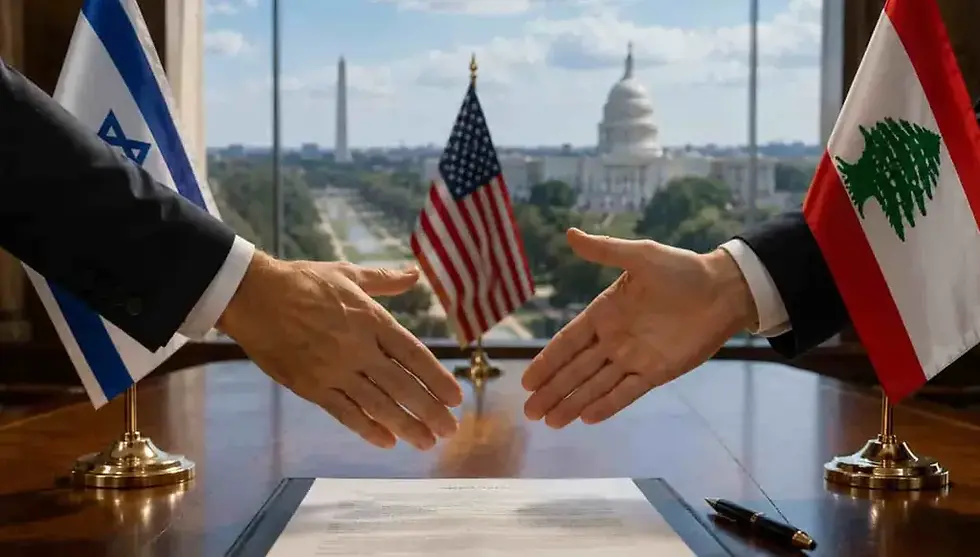
The agreement, signed in Washington on June 26, 2026, creates a practical basis for Israeli withdrawal, the deployment of the Lebanese Armed Forces, the disarmament of Hezbollah, and the dismantling of the militia’s infrastructure.
U.S. Secretary of State Marco Rubio described the process as an orderly one for restoring Lebanon’s sovereignty and enabling Israel to return to its borders once Hezbollah’s threats are removed. No, this is not a peace treaty—but it is, without doubt, a historic agreement, one that creates an institutional possibility for peace.
Unlike ceasefire arrangements, the agreement objectively recognizes the sovereignty of both countries, their borders, their obligations, and their security interests. That recognition alone is a door—one that allows Lebanon to escape its bondage to the fortunes of the Arab-Israeli conflict, and one that challenges the economic and political order that flourished in Lebanon by feeding on conflict and the logic of ruin for decades, after Hezbollah turned Lebanon’s borders into an Iranian strategic asset.
The Lebanese state carried the national banner, signed the treaties, paid the salaries, absorbed the collapses, and knocked on the doors of aid—yet the decision of war and peace remained beyond its control. For Hezbollah’s weapons were never mere military assets. While the party claimed to be protecting Lebanon, the internal contradiction of the game revealed itself: it left Lebanon exposed to the strategic absurdity of a party that sanctifies death for the sake of Iran over life for the sake of Lebanon. “Resistance” became a mechanism through which Lebanon paid the price of decisions it never made.
The Washington agreement offers the counterforce: the Lebanese state, backed by American and European pressure, by Arab interest in stability, and by a Lebanese social demand to escape the economy of militias and permanent emergency. This counterforce is not enough to defeat Hezbollah by decree, but it now possesses a political and legal instrument around which sovereignty can be organized.
Indeed, Hezbollah’s foolish response reveals the importance of the moment. Its deputy leader, Naim Qassem, rejected the agreement, calling it “null and void” and deeming it a surrender—affirming the party’s doctrine of breaching Lebanese sovereignty. Hezbollah does not oppose the agreement because it considers it a weakening of Lebanon—when the civil war it is pushing toward is what would actually destroy Lebanon—but because it weakens the brute domination of Iran and Hezbollah.
The importance of the moment lay in its timing as well. Once again, the Islamabad accord laid bare the historic mutual service between Iran and Hezbollah on one side and the messianic Israeli extremists on the other. By declaring the agreement “a grave mistake,” Ben-Gvir confirmed the convergence of interests between himself and Iran–Hezbollah, as together they entrench their diabolical game of legitimizing an eternal ideological conflict—at the expense of the displaced, the people, and the Lebanese state. For the Islamabad accord hands Lebanon over to Iran, turning it into an arena for the game of Iranian deterrence and ideology, while Hezbollah and its apparatus live off it, retaining a veto over Lebanese sovereignty.
But the Washington agreement, conducted under the stewardship of the U.S. State Department, breaks this organic bond. It transcends that Trumpian oversight crafted by Barrack, Kushner, and Witkoff—an attempt to reduce Lebanon to a mere clause in Iranian negotiations, to fold it into the “wider front,” in the Pakistani phrasing, and to convert Lebanon, contractually, into an eternal bargaining card in Iran’s hand.
By contrast, the agreement carries many risks. They lie in the game of field-movement timetables—step for step—between Israeli withdrawals and progress in clearing the south of Hezbollah’s weapons. This demands, then, that Lebanese political and diplomatic vigilance be sustained, to besiege Hezbollah’s maneuvers and to negotiate firmly with Israel.
The decisive struggle will be inside Lebanon: in the bureaucratic institutions, in security, in border economies, in patronage networks, in municipal influence, in the channels of reconstruction, and in fear. It will not be enough to deploy soldiers in the south; the administrative infrastructure of the militia must be relentlessly dismantled. The heaviest burden will fall on the army, whose legitimacy rests on a national doctrine that is anti-militia and, at once, a friend to and embracing of the Shiites.
Hezbollah may not launch its coup outright, but it will try to paralyze and intimidate the government and the political community, to penetrate the mechanisms of implementation, or to provoke Israel. Herein lies the importance of the external role—as a support for Lebanese political courage, not a substitute for it.
Three scenarios now define the road ahead.
The first is the sovereignty scenario, in which the Washington agreement becomes a lever for reclaiming authority gradually, but irreversibly. It would strengthen the army’s role, confine reconstruction funds to state channels, and draw on Arab and Western support. This scenario does not end every struggle for Lebanon’s survival, but it changes the direction of history.
The second is the sabotage scenario. Hezbollah mobilizes its base and threatens civil strife to force the state to retreat. Israel then resumes its strikes, and Lebanon returns to the vicious circle.
The third is the frozen hybrid, in which the agreement remains formally in place but never truly takes root. Israel stays in security zones, Hezbollah retains hidden capabilities, the army achieves a limited deployment, and the international community wavers over the value of the new course. Unless Lebanon’s leadership and political community act with firmness and historic national skill, there is a danger that this scenario proves the most likely in the short term.
The essential question for Lebanon’s political community is not whether it favors stability, peace, and prosperity, but whether it is prepared to abandon the system and the interests of the past and to support the rebuilding of a sovereign Lebanese state.
The historic significance of the Washington agreement lies not in its capacity to guarantee peace for Lebanon, but in its exposure of the central contradiction of Lebanon’s postwar order. Lebanon cannot liberate its land from Israel without liberating it from Iran. Sovereignty is the essential precondition for achieving the liberation of the land. Article Link https://www.annahar.com/articles/annahar-writers/324974/%D9%87%D9%84-%D9%8A%D8%B1%D8%AA%D9%82%D9%8A-%D8%A7%D9%84%D8%B3%D9%8A%D8%A7%D8%B3%D9%8A%D9%88%D9%86-%D8%A7%D9%84%D9%84%D8%A8%D9%86%D8%A7%D9%86%D9%8A%D9%88%D9%86-%D8%A5%D9%84%D9%89-%D8%A3%D9%87%D9%85%D9%8A%D8%A9-%D9%87%D8%B0%D9%87-%D8%A7%D9%84%D9%84%D8%AD%D8%B8%D8%A9


Comments