
When Tactical Victory Becomes a Strategic Trap,There Is No Exit but Diplomacy
- sara john
- Mar 20
- 4 min read

Samir al-Taqi
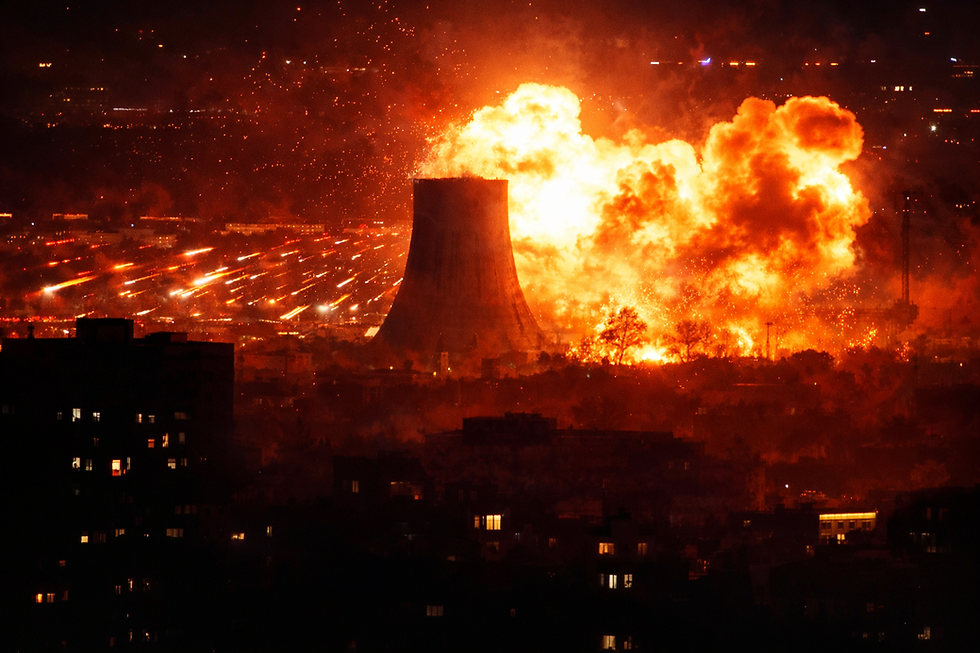
The first strike tempted many with an old illusion: that swift military decisiveness can, on its own, produce a conclusive victory. The logic seemed simple. Strike the leadership, paralyze the missile infrastructure, penetrate defenses, and the Iranian regime would begin to unravel under the shock. In such moments, power appears as though it can compress history into an instant.
But wars are not measured by their first day; they are measured by what remains unresolved afterward. Here, the dilemma begins.
Israel, along with the United States, has achieved clear operational gains. Missile bases, production facilities, and segments of Iran’s air and naval defenses have been struck. These attacks have revealed deep strategic and security vulnerabilities within Iran’s military structure. Yet the issue is not locating this commander or that target, nor expanding the list of objectives, but rather the ability to translate military superiority into a sustainable political outcome. That is the true test.
So far, the American wager does not appear to have delivered what was expected. The notion that decapitating the regime would suffice to dismantle it has not proven itself. The initial strike did not produce rapid internal collapse, nor did it create a vacuum that could automatically lead to an orderly political transition. Iranian crowds did not take to the streets in the way advocates of “sufficient shock” had imagined. Nor do key components—among them the Kurds—trust Trump’s easy promises.
Yet the deeper dilemma lies elsewhere—in what bombs cannot destroy: sensitive nuclear materials and what remains beyond full visibility. As long as stockpiles of 60 percent enriched uranium, capable of producing several crude nuclear weapons, remain unresolved, the strike ceases to be a conclusion and instead becomes an entry point for reproducing and expanding the crisis.
Thus, the effectiveness of strikes in nuclear contexts is not measured by the number of buildings destroyed, but by the degree of certainty produced after their destruction. When certainty declines, the risk of escalation rises.
Here lies the trap. The more fundamental questions remain unanswered, the greater the pressure to complete the mission. What begins as a limited war against a known military structure can quickly turn into an open-ended pursuit of what is no longer known.
At that point, war ceases to be an instrument of control and becomes a forced search for lost certainty. This is a dangerous moment: when initial success becomes justification for a second round, then a third, without a clear vision of the end.
On the other hand, Iranian behavior does not suggest the existence of a clear exit strategy. Tehran appears inclined to expand the war horizontally—not because it is confident in its ability to reverse the balance, but because its options are narrowing. Regimes under siege often escalate risk as a way to avoid internal acknowledgment of weakness. In this sense, expanding the war is less a sign of cohesion than an indication of the depth of the crisis.
This crisis deepens as Iran itself enters a delicate transitional phase. In moments of existential threat, authority tends not toward moderation but toward rigidity. If centers of power within the regime shift further toward hardliners in the Revolutionary Guard, the space for political decision-making narrows dramatically. Even if Mojtaba Khamenei emerges at the core of a new arrangement, his legitimacy would not rest on strategic political consensus but on the approval of the security apparatus that effectively controls the instruments of coercion. This does not expand options; it constrains them to more impulsive and less rational alternatives.
Thus, Tehran faces a harsh dilemma. It cannot respond symmetrically to Israeli and American air superiority. Yet it can—and likely will—raise the cost of war through other means: threatening maritime routes, targeting economic interests, pressuring bases and partners, and widening the scope of confrontation. This is not a strategy for victory, but one of disruption, destruction, and defeat.
However, the dilemma is not Iran’s alone. The United States is also discovering the limits of power when foreign policy is conducted through the logic of humiliation rather than partnership.
Donald Trump spent considerable time belittling Europeans, yet now seeks their assistance to protect maritime routes and contain the economic repercussions of war. Europe, however, is not rushing this time. It hesitates, calculates its interests, and avoids full engagement in a war in which it was not properly consulted.
As for the expectation that Moscow might reshape its position to please a personal relationship with Trump, this reflects a misunderstanding of Russian policy. The relationship between Moscow and Tehran runs deeper than transient moods in the White House. China, for its part, does not appear willing to allow a complete Iranian collapse. What emerges, then, is a disordered international landscape: no actor is willing to go far enough to achieve decisive resolution, yet none wishes to be excluded from the equation.
The war thus resembles less a confrontation between victor and vanquished, and more a race between two impasses.
Israel and the United States possess clear military and intelligence superiority, yet they lack a reliable roadmap for translating this advantage into a more stable regional order. Iran, meanwhile, retains a significant capacity for disruption and cost escalation, but lacks a realistic path to overturn the final outcome.
Both sides, therefore, find themselves trapped in a sterile equation.
Washington cannot pursue an open-ended conflict without paying costs far exceeding its initial objectives. Nor can Tehran escalate indefinitely without accelerating its own internal deterioration and exhausting its remaining margins.
From this perspective, Gulf diplomacy regains its necessity—not as a moral luxury, but as the only instrument capable of breaking the logic of this chaotic war, which offers no clear horizon for any party.
Having long sought to prevent war, the Arab Gulf states now extend their hand to contain the conflict, acquiring a vital role in shaping its trajectory. They do so not because they stand equidistant from the crisis, but because they are best positioned to understand what an open war in this region entails: energy instability, threats to navigation, the involvement of major powers, and the erosion of what remains of the regional order. Their efforts to contain the crisis are not naive neutrality, but a direct strategic interest.
Wars often begin with the illusion of control. They end, more often than not, when all parties realize that the cost has exceeded the promise that launched them. To prevent a tactical victory from becoming a strategic trap, there is no sustainable exit from this war except through diplomacy. Article Link https://www.annahar.com/articles/annahar-writers/289057/حين-يصبح-النصر-التكتيكي-فخا-استراتيجيا-لا-يبقى-من-مخرج-إلا-الديبلوماسية


Comments